Introduction
Image : Pexels / Akil Mazumder
Sustainable finance is everywhere. In speeches, strategies, reports, and training courses!
However, the more the term is used, the more vague it becomes. Everyone seems to project their own definition, priorities, and tools onto it. As a result, we often think we understand it… without actually talking about the same thing.
This article does not seek to provide a definitive definition of sustainable finance. Instead, it proposes six key questions that show why the subject is more complex—and more fundamental—than it appears.
1. Is sustainable finance really a new form of finance?
It is often presented as a radical departure from the past. In reality, it is more a gradual transformation of existing finance.
The mechanisms remain the same: capital allocation, risk management, performance seeking. What changes are the criteria taken into account, the time horizons, and expectations in terms of transparency.
This nuance is essential!
2. Are we talking about impact, transition, or compliance?
Behind the term “sustainable finance” lie very different approaches.
Some aim to measure a quantifiable positive impact. Others seek to support the transition of existing activities. Still others primarily respond to regulatory requirements.
These approaches coexist, but do not share the same objectives. Confusing them is a mistake.
3. Are regulatory frameworks sufficient to define what is sustainable?
SFDR, taxonomy, CSRD. European frameworks provide structure and transparency.
But they don’t tell the whole story. They provide a framework for statements, organize information, and make certain choices comparable. They are no substitute for strategy, trade-offs, or judgment.
Knowing where the rules end and analysis begins remains key!
4. Is it easy to compare two so-called sustainable strategies?
This is often what people expect.
In practice, comparability remains partial. Indicators differ, as do methodologies, and scopes are not always equivalent.
Frameworks are improving, but interpretation remains challenging. It is illusory to think that everything is now directly comparable.
5. Is greenwashing a communication or comprehension issue?
Greenwashing is often approached from a moral perspective.
But in many cases, it mainly reveals a lack of understanding of concepts, tools, and their limitations. When frameworks are poorly understood, communication becomes fragile and sometimes unintentionally misleading.
The boundary is rarely as clear-cut as we imagine.
6. Why does sustainable finance create so much tension?
Because it forces us to make long-standing implicit trade-offs visible.
Between financial performance, environmental impacts, regulatory constraints, and societal expectations, the balance is complex. Sustainable finance does not simplify these tensions; it exposes them.
And that is precisely what makes it difficult to understand.
What these questions reveal
Sustainable finance is neither a slogan nor a set of ready-made recipes!
It is a language under construction, made up of frameworks, indicators, choices, and compromises. The more structured it becomes, the more it requires a keen ability to interpret it.
Understanding sustainable finance is not just about knowing definitions. It is about knowing how to connect the frameworks and grasp their real implications.
Going further: laying solid foundations
If these questions seem more open-ended than conclusive, that is intentional!
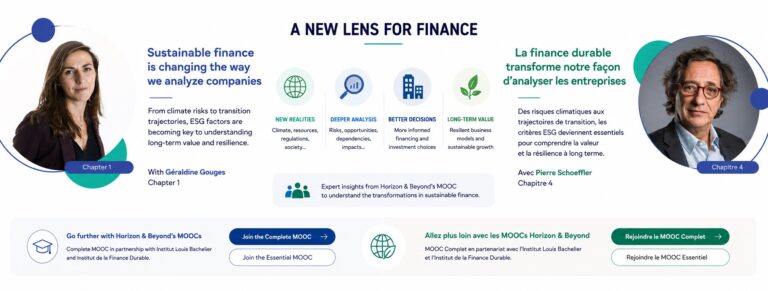
The Essential Sustainable Finance MOOC offered by Horizon & Beyond Foundation allows you, in less than two hours, to structure these concepts, understand the major European frameworks, and gain a clear understanding of their uses.
👉 Register for Horizon & Beyond’s Essential MOOC to move from questions to keys to understanding.