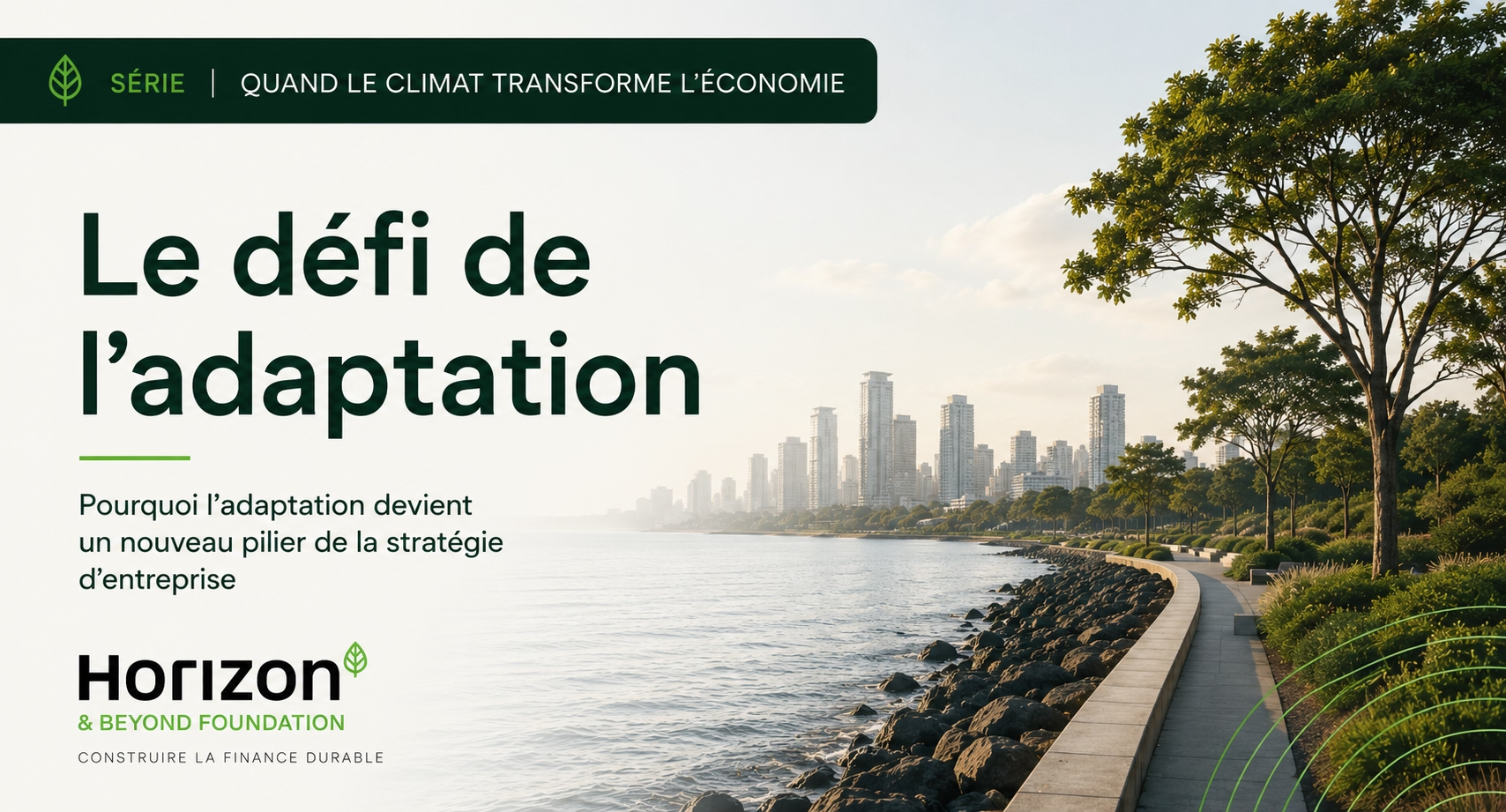
- Climate adaptation is emerging as a new pillar of corporate strategy, complementing traditional mitigation efforts, because the physical impacts of climate change—such as heatwaves, water stress, and supply chain disruptions—are already affecting business operations.
- Unlike mitigation, which focuses on reducing greenhouse gas emissions, adaptation aims to reduce the vulnerability of businesses, infrastructure, and communities to climate impacts that are already being observed.
- Companies must now assess whether their production sites, supply chains, critical resources, and infrastructure are resilient enough to withstand increasingly frequent extreme weather events and resource pressures.
- For investors, physical climate risks are becoming as important as transition risks, making a company's ability to adapt a potential competitive differentiator even among firms with similar financial performance.
- Adaptation is shifting from being perceived as an additional cost to being recognized as a source of competitive advantage, improving business continuity, securing supply chains, and supporting long-term investment capacity.
For many years, corporate climate strategies have primarily focused on one objective: reducing greenhouse gas emissions.
Decarbonisation, energy efficiency, renewable energy, electrification and sustainable finance have gradually become the foundations of corporate climate roadmaps.
This remains, of course, essential.
However, another reality is increasingly impossible to ignore: climate change is no longer simply a future risk that we hope to avoid. Many of its consequences are already visible today.
Recurring heatwaves, droughts, water stress, extreme weather events, supply chain disruptions, rising insurance costs and increasing pressure on critical infrastructure are gradually becoming economic realities.
As a result, companies are beginning to ask a new question:
How can we continue creating value in a world that is already changing?
Climate adaptation is increasingly becoming a new pillar of corporate strategy.
Two complementary approaches: mitigation and adaptation
Climate action relies on two complementary approaches.
The first is now widely understood: mitigation. Its objective is to reduce greenhouse gas emissions in order to limit the scale of global warming.
The second is adaptation. Its objective is different: reducing the vulnerability of businesses, infrastructure and communities to the impacts of climate change that are already being observed.
These two approaches are not in opposition.
On the contrary, they are becoming increasingly complementary.
Reducing emissions remains essential.
But companies must also learn to operate in a world where extreme weather events are becoming more frequent and where certain resources are under growing pressure.
Why adaptation is becoming increasingly important
Several trends are converging.
Temperature records continue to be broken.
Heatwaves affect both employee health and productivity.
Infrastructure is under increasing strain.
Supply chains remain fragile.
Water stress and pressure on certain raw materials are becoming more visible.
The economic cost of natural disasters continues to rise across many countries.
These developments are no longer concerns only for sustainability teams.
They are increasingly involving executive leadership, finance departments, risk management teams, operations leaders and boards of directors.
Climate adaptation is gradually becoming a governance issue.
What this means in practice for businesses
For many years, a corporate climate strategy mainly focused on reducing carbon emissions.
Today, companies are also questioning their own ability to operate successfully in a more volatile environment.
For example:
- Are production sites exposed to heatwaves or flooding?
- Do certain business activities depend on resources whose availability may become more uncertain?
- Are critical suppliers concentrated in particularly vulnerable regions?
- Will buildings and infrastructure remain suitable under future climate conditions?
- Do business continuity plans adequately account for climate-related physical risks?
These questions extend far beyond environmental considerations.
They also concern industrial strategy, capital investment, procurement, human resources, risk management and corporate governance.
In other words, adaptation is increasingly becoming a core element of business management.
What this means for investors
Investors have long been familiar with transition risks, such as regulatory changes, market transformations and technological disruption.
Physical climate risks are now becoming increasingly important.
They can affect business continuity, resource availability, operational performance, asset values and the long-term profitability of investments.
As a result, two companies with similar financial performance may display very different levels of preparedness for the physical consequences of climate change.
The ability to adapt is gradually becoming a competitive differentiator.
A new dimension of resilience
In our previous article, we explained why the transition is also becoming a question of resilience.
Climate adaptation is one of its most tangible expressions.
Being resilient is no longer simply about responding after a crisis has occurred.
It means anticipating vulnerabilities, identifying critical dependencies and progressively strengthening an organisation’s ability to continue operating despite disruption.
This applies not only to infrastructure, but also to value chains, resources, employees and business models.
Adaptation is also becoming a competitiveness issue
For a long time, adaptation was often perceived as an additional cost.
Today, that perception is changing.
Companies that anticipate the impacts of climate change can improve business continuity, reduce vulnerabilities, secure supply chains and strengthen their ability to invest over the long term.
Conversely, organisations that are insufficiently prepared may become more exposed to operational disruptions, resource constraints, rising insurance costs and operational challenges.
Adaptation is therefore no longer simply a matter of risk management.
It is increasingly becoming a source of competitive advantage.
A transformation that is only just beginning
Not all companies will face the same challenges.
The issues vary depending on sectors, geographical locations, business models and value chains.
However, one trend is becoming increasingly clear.
Climate strategies are no longer limited to reducing emissions.
They are gradually incorporating organisations’ ability to operate successfully in a world already transformed by climate change.
Adaptation does not replace decarbonisation efforts.
It complements them.
And in the years ahead, it could become one of the key pillars of both corporate strategy and investment decision-making.
In the next article
In the next article of this series, we will explore why the cost of inaction is increasingly becoming a key factor in economic decision-making.
Learn more
Understanding sustainable finance is not only about mastering regulations or ESG indicators.
It is also about understanding how climate change is gradually transforming businesses, investments and economic decision-making.
👉 Join the Horizon & Beyond Complete MOOC, developed in partnership with the Institut Louis Bachelier and the Institut de la Finance Durable, to deepen your understanding of the transition, resilience, climate risks and sustainable finance.
👉 Join the Horizon & Beyond Essentials MOOC to build a solid foundation in sustainable finance in less than two hours.
Get in touch with us to know more about our initiatives: Link.
Visit our website: Link.
Frequently Asked Questions
Climate mitigation focuses on reducing greenhouse gas emissions to limit the scale of global warming, while climate adaptation aims to reduce the vulnerability of businesses, infrastructure and communities to climate impacts that are already occurring. These two approaches are complementary — companies must both reduce emissions and learn to operate in an increasingly volatile climate environment.
Climate adaptation is becoming critical because the physical impacts of climate change — such as heatwaves, droughts, supply chain disruptions and rising insurance costs — are already affecting business operations. Companies must now assess whether their production sites, suppliers and infrastructure can withstand these growing risks, making adaptation a core element of business management and governance.
Investors are increasingly factoring physical climate risks into their analysis, as these risks can affect business continuity, asset values and long-term profitability. Two companies with similar financial performance may have very different levels of climate preparedness, making the ability to adapt a growing competitive differentiator in investment decision-making.
While adaptation was long perceived as an additional cost, it is increasingly viewed as a source of competitive advantage. Companies that anticipate climate impacts can improve business continuity, secure supply chains and reduce vulnerabilities, while insufficiently prepared organisations face greater exposure to operational disruptions and rising costs.
Companies should evaluate whether their production sites are exposed to heatwaves or flooding, whether key resources may become scarce, whether critical suppliers are in vulnerable regions, and whether business continuity plans account for physical climate risks. These questions extend beyond environmental concerns to encompass industrial strategy, capital investment, procurement and governance.