- A +2°C increase in global average temperature does not mean uniform warming everywhere, but entails significant regional differences including more intense heat extremes, heavier precipitation, severe droughts, and rising sea levels, with risks increasing at every fraction of additional warming according to the IPCC.
- Natural catastrophes generated USD 318 billion in global economic losses in 2024, of which USD 181 billion were uninsured, confirming that climate-related physical risks are now a structural economic trend rather than exceptional events.
- Businesses must assess not only their carbon footprint but also their operational resilience under changing climate conditions, including the suitability of industrial sites, access to critical resources, supply chain diversification, and workforce impacts such as the ILO's projection that heat stress could reduce global working hours by over 2% by 2030.
- Investors need to look beyond traditional financial metrics and transition policies to evaluate companies' exposure to physical climate risks, considering factors like asset location, resource dependence, infrastructure resilience, and value chain robustness for more informed long-term analysis.
- Climate is now an economic, industrial, financial, and strategic factor that intersects with water scarcity, biodiversity loss, critical raw material availability, and geopolitical change, making resilience and adaptation investments not just risk management tools but potential sources of competitive advantage.
For many years, climate change was primarily viewed as an environmental issue or a long-term risk. But that perspective is no longer sufficient. Heatwaves, droughts, floods, and increasing pressure on critical resources are clear reminders that its impacts are already affecting the real economy. For businesses and investors alike, the challenge is no longer just about preparing for the future. It is also about understanding how a more unstable climate weighs on economic decision-making and what continued warming towards +2°C could mean for the economy.
A Reality Beyond Climate Scenarios
Climate scenarios are used to anticipate the potential consequences of global warming by 2050 or 2100. This approach remains essential, but some of the phenomena they examine are already observable.
Extreme heat events are becoming more frequent, droughts are intensifying in many regions, climate-related events are disrupting infrastructure, supply chains, and agricultural production, while pressures on water availability and natural resources continue to increase.
Climate risk is therefore no longer purely prospective. It is already affecting businesses, regions, and financial markets.
What Does a +2°C World Actually Mean?
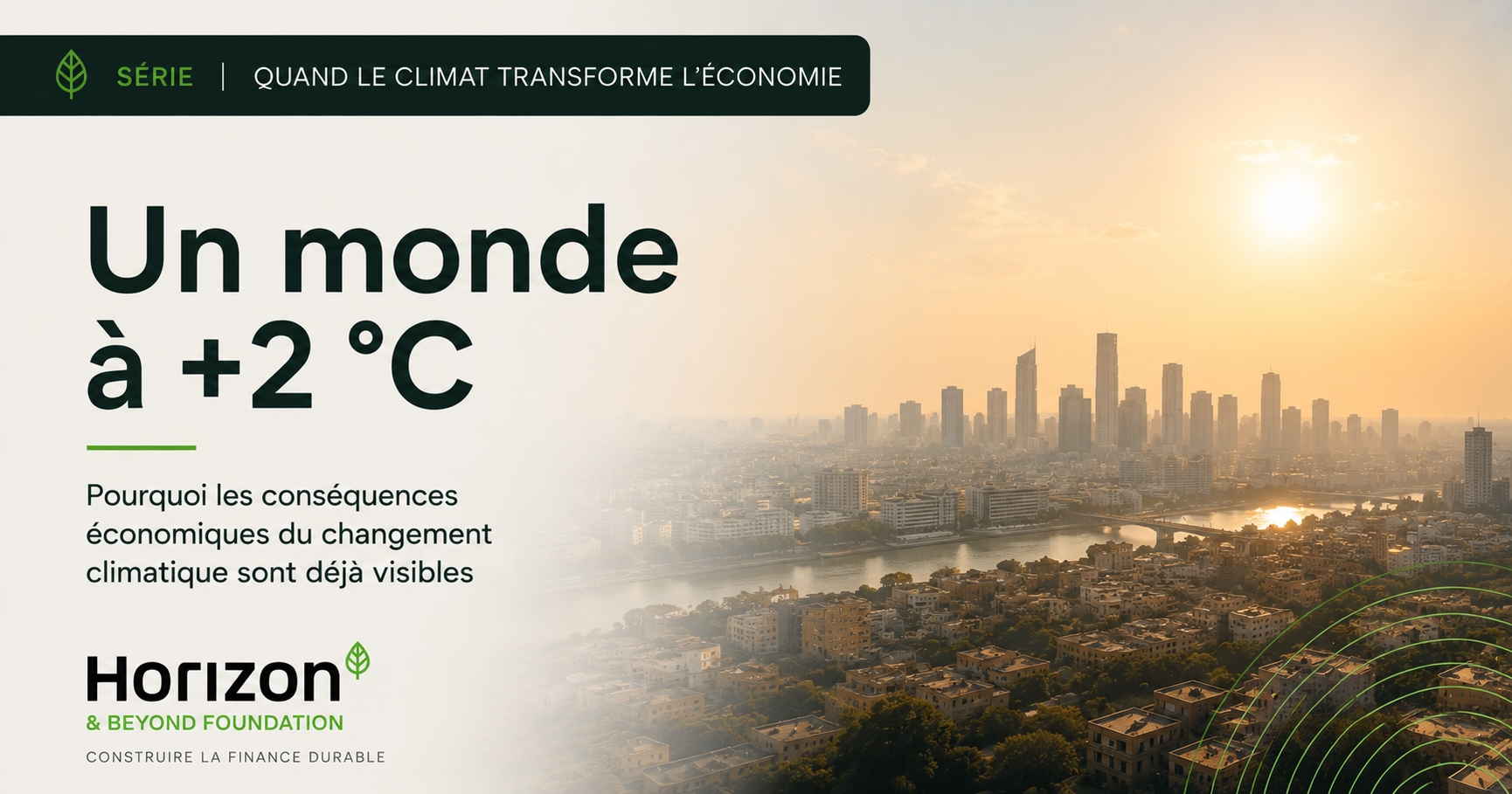
+2°C does not mean that temperatures will be two degrees higher everywhere. It refers to an increase in global average temperature compared with pre-industrial levels. Behind this global average lie significant regional differences, including more intense heat extremes, heavier precipitation in some areas, more severe droughts in others, and rising sea levels.
According to the Intergovernmental Panel on Climate Change (IPCC), climate-related risks and losses increase with every additional fraction of warming. At +2°C, risks are generally higher than at +1.5°C, particularly for ecosystems, food and water security, health, and infrastructure.
For economic actors, the +2°C threshold is therefore more than a climate indicator. It provides a way to consider an environment in which certain physical risks become more frequent or severe, potentially affecting operating conditions, investment decisions, and insurance.
Impacts That Extend Far Beyond the Environment
These impacts are transmitted to the economy through multiple channels: productivity, infrastructure, supply chains, insurance costs, property markets, natural resources, and the stability of value chains.
The cost of natural disasters provides a tangible illustration. According to the Swiss Re Institute, natural catastrophes generated USD 318 billion in global economic losses in 2024, of which USD 181 billion were uninsured, highlighting the scale of the global protection gap.
Insured losses from natural catastrophes have also exceeded USD 100 billion per year for several consecutive years, confirming that these events are no longer exceptional but part of a structural trend.
The impacts vary significantly across industries and regions. Yet they point to the same conclusion: the conditions under which businesses create value are increasingly exposed to physical hazards. Organizations are therefore being driven to integrate these risks more fully into strategic decision-making.
What This Means in Practice for Businesses
For companies, the challenge is not only to reduce their carbon footprint, but also to assess their ability to operate under changing climate conditions.
For example:
- Will industrial sites remain suitable as heatwaves become more frequent?
- Could access to critical resources become more constrained?
- Are suppliers sufficiently diversified to reduce the risk of supply chain disruptions?
- Are critical infrastructures resilient enough?
- Do business continuity plans adequately incorporate physical climate risks?
The workforce is also affected. According to the International Labour Organization (ILO), heat stress could reduce global working hours by more than 2% by 2030, equivalent to the loss of approximately 80 million full-time jobs.
Adaptation is therefore becoming a cross-cutting issue, affecting strategy, operations, investment decisions, procurement, human resources, and corporate governance.
What This Means in Practice for Investors
For investors, climate analysis covers not only transition policies and greenhouse gas emissions, but also a company’s ability to maintain its performance in a more unstable environment.
Two companies operating in the same industry may report similar financial results. Yet their level of exposure may differ significantly depending on the location of their assets, their dependence on critical resources, the resilience of their infrastructure, or the robustness of their value chains. These are all factors that can enrich long-term investment analysis.
A New Perspective on Value Creation
For decades, economic performance was primarily assessed through financial indicators such as revenue, profitability, investment, and productivity.
Other dimensions now complement this analysis. The ability to anticipate physical risks, secure strategic resources, adapt infrastructure, and strengthen business continuity also influences value creation.
Adaptation investments therefore take on a very tangible economic dimension. According to the Swiss Re Institute, certain prevention and adaptation measures can cost up to ten times less than rebuilding after a major disaster.
Resilience is no longer simply a matter of risk management. It can also become a source of competitive advantage.
The Economy Is Entering a New Phase
These changes do not stop at climate. They intersect with pressures on water resources, biodiversity loss, the availability of critical raw materials, infrastructure resilience, supply chain security, and geopolitical change.
These issues were often analyzed separately. Today, they appear increasingly interconnected and raise broader questions about the robustness of economies facing multiple constraints. Businesses, investors, and financial institutions must therefore broaden the way they assess risks and opportunities.
The World Economic Forum consistently ranks climate and environmental risks among the world’s most significant long-term risks, alongside geopolitical and technological threats. This is another indication that climate has entered the realm of economic and strategic concerns.
A Transformation That Has Only Just Begun
Not all companies will face the same challenges. The risks vary depending on sectors, geographies, business models, and value chains. Yet a common conclusion is emerging: climate is becoming an economic, industrial, financial, and strategic factor.
Understanding a warmer world is therefore no longer limited to analyzing climate trajectories. It also means understanding what they imply for the conditions of production, investment, financing, and value creation.
This four-part series has explored this transformation from four complementary perspectives: resilience, adaptation, the cost of inaction, and the economic consequences of a warmer climate. Together, they show how climate is becoming part of the debate around strategy, competitiveness, investment, and value creation. A shift that is also reshaping the role of sustainable finance.
Links to the previous articles:
Sources
- Intergovernmental Panel on Climate Change (IPCC) – Climate Change 2023: Synthesis Report – Summary for Policymakers, on the increase in climate risks and impacts as global warming rises, particularly between +1.5°C and +2°C. IPCC – AR6 Synthesis Report, Summary for Policymakers / Figure SPM.3
- Swiss Re Institute – sigma 1/2025: Natural catastrophes: insured losses on trend to USD 145 billion in 2025 (USD 318 billion in global economic losses in 2024, including USD 181 billion uninsured).
- Swiss Re Institute – NatCat 2025 (structural increase in insured losses and the economic value of adaptation measures).
- International Labour Organization (ILO) – Working on a Warmer Planet: The Impact of Heat Stress on Labour Productivity and Decent Work (the equivalent of 80 million full-time jobs at risk by 2030 due to heat stress).
- World Economic Forum – Global Risks Report 2026 (climate and environmental risks among the world’s leading long-term risks).
Going Further
Understanding sustainable finance is not only about mastering regulations or ESG indicators. It is also about understanding how climate is changing the conditions under which businesses and investors make decisions.
👉 Join Horizon & Beyond’s Complete MOOC, developed in partnership with the Institut Louis Bachelier and the Institut de la Finance Durable, to deepen your understanding of the transition, resilience, physical climate risks, and sustainable finance.
👉 Join Horizon & Beyond’s Essential MOOC to learn the fundamentals of sustainable finance in less than two hours.
Frequently Asked Questions
A +2°C increase refers to the rise in global average temperature compared to pre-industrial levels, which translates into more intense heat extremes, heavier precipitation, severe droughts, and rising sea levels across different regions. For economic actors, this threshold signals an environment where physical risks become more frequent and severe, directly affecting operating conditions, investment decisions, and insurance costs.
According to the Swiss Re Institute, natural catastrophes generated USD 318 billion in global economic losses in 2024, of which USD 181 billion were uninsured. Insured losses have exceeded USD 100 billion per year for several consecutive years, confirming that these events are now part of a structural economic trend rather than exceptional occurrences.
Climate change challenges businesses across multiple dimensions, from the suitability of industrial sites during more frequent heatwaves to constrained access to critical resources and supply chain disruptions. The ILO estimates that heat stress alone could reduce global working hours by more than 2% by 2030, equivalent to approximately 80 million full-time jobs, making climate adaptation a cross-cutting strategic issue.
Two companies in the same industry may report similar financial results yet face very different levels of climate exposure depending on asset locations, resource dependencies, infrastructure resilience, and value chain robustness. Integrating physical climate risks into investment analysis helps investors identify vulnerabilities that traditional financial indicators alone may not reveal, enriching long-term decision-making.
Climate adaptation can be both, but evidence increasingly points to it as a competitive advantage. According to the Swiss Re Institute, prevention and adaptation measures can cost up to ten times less than rebuilding after a major disaster. Companies that anticipate physical risks, secure strategic resources, and strengthen business continuity are better positioned to create and protect long-term value.