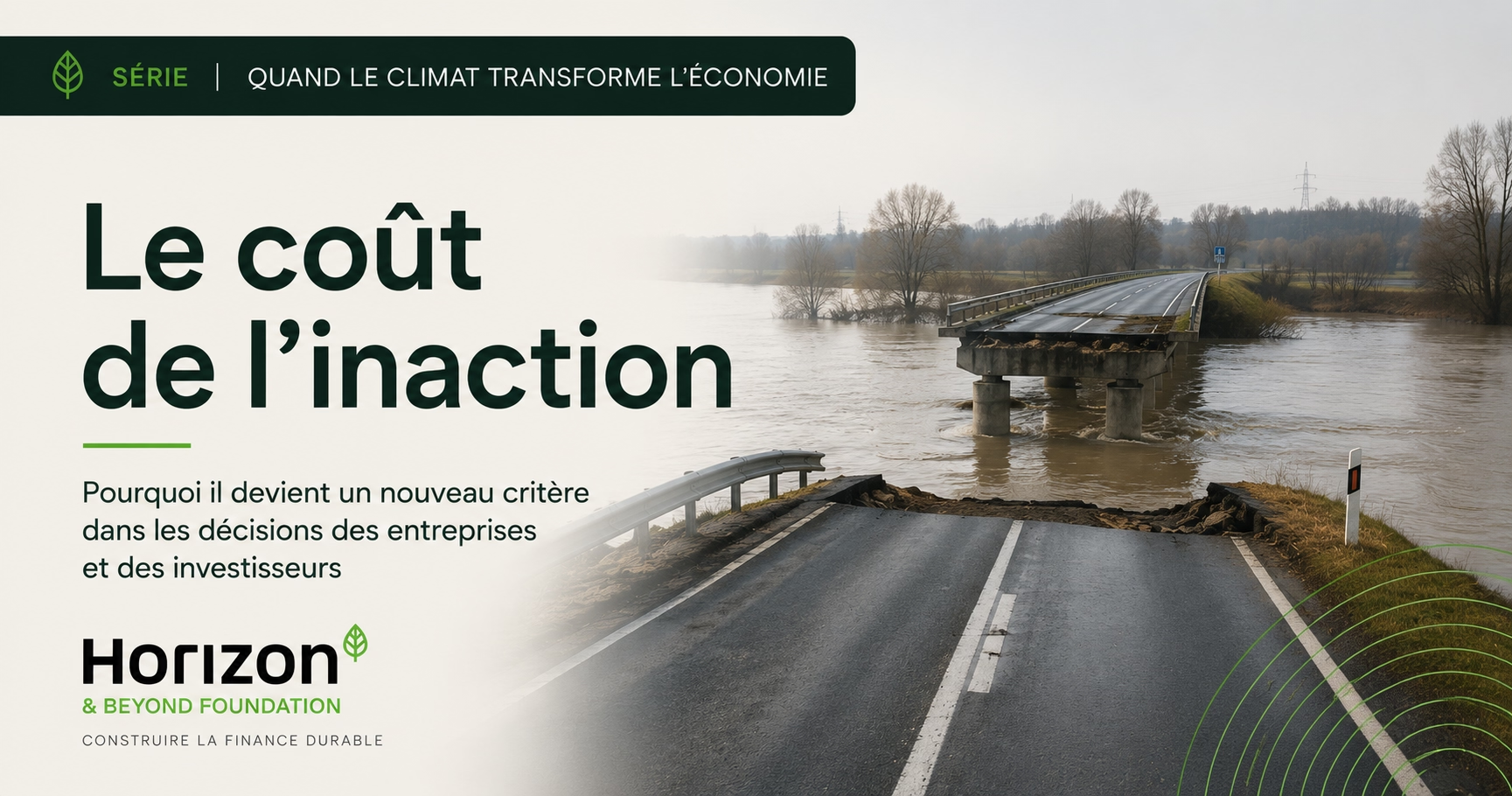
- The cost of inaction—meaning the economic consequences of delaying investments or failing to address vulnerabilities—is becoming a critical criterion in both corporate strategy and investment decisions.
- Companies are shifting from viewing transition-related projects as mere expenses to comparing two scenarios: the cost of investing today versus the potentially greater cost of bearing the consequences of not investing tomorrow.
- Climate-related events such as heatwaves, floods, supply chain disruptions, and water stress are already generating tangible economic impacts including business interruptions, lower productivity, rising insurance costs, and resource scarcity.
- For investors, assessing a company's long-term value now includes evaluating its resilience, preparedness for physical climate risks, and ability to operate in a more constrained environment—not just its current financial performance.
- The cost-of-inaction framework extends beyond climate to encompass pressure on natural resources, biodiversity loss, critical infrastructure vulnerabilities, and geopolitical dependencies, reflecting a broader return to long-term economic thinking.
Why the Cost of Inaction Is Becoming a New Criterion in Business and Investor Decision-Making
Until now, transition-related investments have primarily been assessed through the lens of their cost. Today, the question is evolving. Faced with climate change, pressure on resources and new market expectations, companies and investors are increasingly considering the cost of doing nothing. This is changing the way risks, investments and value creation are assessed.
Transition-related projects are often perceived as additional expenses. Renovating a building, modernizing industrial equipment, diversifying suppliers, strengthening infrastructure or improving energy efficiency primarily represent investment costs.
This logic has not disappeared, but another question is emerging in strategic discussions: What is the cost of inaction?
What could be the economic consequences of postponing an investment, leaving a vulnerability unaddressed or failing to anticipate a dependency? This reflects a profound shift in perspective.
A new way of thinking
Companies no longer systematically compare the cost of an investment with a supposedly stable baseline scenario. They are beginning to compare two scenarios: investing today or bearing the consequences of not investing tomorrow.
This approach is now explicitly used in work on climate change adaptation. The European Environment Agency notably proposes considering three elements together: the cost of inaction, the cost of adaptation and the benefits of adaptation. It defines the cost of inaction as the economic cost of climate change in the absence of planned adaptation. Source: European Environment Agency, Assessing the costs and benefits of climate change adaptation.
This approach incorporates new dimensions into economic analyses:
- business continuity
- resource availability
- infrastructure robustness
- value chain resilience
- a company’s ability to maintain its performance in a more unstable environment.
The analysis is no longer focused solely on the cost of action. It also considers the potential cost of inaction.
Costs that are becoming more visible
This shift is taking place because some of the consequences of climate change are no longer confined to future scenarios. Heatwaves, droughts, floods, water stress, extreme weather events and logistical disruptions are already having economic impacts.
According to the World Economic Forum, climate-related disasters have caused more than $3.6 trillion in damages worldwide since 2000. Its report The Cost of Inaction: A CEO Guide to Navigating Climate Risk, published with Boston Consulting Group, highlights that physical climate risks and transition risks are already affecting markets and business models.
In Europe, the European Environment Agency estimated that economic losses from weather- and climate-related extremes exceeded €560 billion between 1980 and 2021, with only one-quarter to one-third of these losses insured. Source: European Environment Agency.
Depending on the sector, this can result in business interruptions, lower productivity during periods of extreme heat, supply difficulties, higher insurance costs, faster deterioration of certain infrastructure or increased costs associated with specific resources.
Taken individually, each of these phenomena may appear temporary. Together, they are changing the economic conditions in which companies operate.
What this means in practice for a company
Beyond emissions reduction targets, executive teams are considering highly operational questions:
- will production sites remain suitable under future climate conditions?
- are certain suppliers particularly exposed to physical risks?
- is critical infrastructure sufficiently resilient?
- do business continuity plans incorporate emerging climate risks?
- could certain dependencies undermine the business model over the long term?
Adaptation is therefore becoming a governance issue as much as an environmental one.
The economic stakes are significant. The World Economic Forum highlights that companies investing in adaptation, resilience and decarbonization can generate substantial economic benefits, with some initiatives studied generating up to $19 in value for every dollar invested. Source: World Economic Forum.
The question is no longer simply how much an investment costs, but also what costs, losses or vulnerabilities it can help avoid.
What this means in practice for an investor
For investors, analysis is no longer focused solely on a company’s current financial performance. It also considers its ability to operate in a more constrained environment.
Two companies may currently report comparable financial results. Yet their long-term prospects may differ significantly if one has already identified its main vulnerabilities, secured critical resources or strengthened the resilience of its assets. The cost of inaction therefore becomes an additional factor in assessing risk and value creation.
The European Central Bank’s work illustrates this shift. Its climate stress test, conducted on more than four million companies and 1,600 banks in the euro area, concludes that starting the transition sufficiently early can limit long-term risks. In a scenario in which climate change is not addressed, the average probability of default for euro-area banks’ corporate loan portfolios would be 8% higher in 2050 than under an orderly transition scenario. Source: European Central Bank, Economy-wide climate stress test.
For portfolios that are most vulnerable to climate risks, the gap is even greater.
More recently, investors have begun to directly incorporate these risks into their analytical frameworks. Allspring Global Investments, for example, highlights that climate inaction can contribute to eroding asset values, widening credit spreads and increasing volatility, particularly in agriculture, real estate, insurance and energy infrastructure. Source: Allspring Global Investments, The Cost of Inaction: Physical Risk & Adaptation.
The cost of inaction is therefore becoming an additional factor in assessing risk and value creation.
A rationale that extends beyond climate
This line of thinking extends well beyond climate issues. It also concerns:
- pressure on natural resources
- water availability
- biodiversity
- supply chains
- critical infrastructure
- certain geopolitical dependencies.
In France, France Stratégie’s work on the cost of climate inaction illustrates this diversity. The analysis notably covers water, agriculture, forests, coastal risks, biodiversity, energy, infrastructure and networks, buildings, tourism and health. It also highlights how complex and uneven the economic quantification of these risks remains across sectors. Source: France Stratégie, The Cost of Inaction on Climate Change in France: What Do We Know? 2023.
What is the economic cost of a vulnerability that was not anticipated?
The return of long-term thinking
This shift also reflects a return to long-term thinking in economic decision-making. For several decades, analyses have often focused on immediate costs. Today, companies and investors are seeking to incorporate costs that may materialize over several years.
The ECB’s work illustrates this tension between the short and long term. Its simulations show that the short-term costs of an early climate transition can be offset by the long-term benefits associated with reducing physical risks. Conversely, delaying investment reduces immediate efforts but increases future exposure to climate risks. Source: European Central Bank, Need for speed on the Road to Paris.
This approach does not call the pursuit of performance into question. It broadens economic analysis by incorporating risks, dependencies and vulnerabilities that were sometimes considered secondary.
A transformation that is only beginning
Not all companies will face the same challenges. The issues vary depending on sectors, geographies, business models and value chains.
Measuring the cost of inaction also remains imperfect. France Stratégie notably highlights the diversity of methodologies and the difficulty of assigning a monetary value to certain climate-related damages. There is therefore not always a single figure that makes it possible to simply arbitrate between action and inaction.
But a trend is emerging. Investment decisions are no longer assessed solely through their immediate cost. They are also increasingly analyzed in terms of the costs they may potentially help avoid. The cost of inaction is becoming a new lens through which to assess corporate strategies, investments and long-term value creation.
The next article in this mini-series will broaden the perspective by exploring how a warmer world is already reshaping economic balances.
To learn more
Understanding sustainable finance is not only about mastering regulations or ESG indicators. It also means understanding how climate, economic and geopolitical transformations are reshaping the decisions made by companies and investors.
👉 Join Horizon & Beyond’s Complete MOOC, developed in partnership with the Institut Louis Bachelier and the Institut de la Finance Durable, to deepen your understanding of resilience, climate risks, double materiality and sustainable finance.
👉 Join Horizon & Beyond’s Essentials MOOC to learn the fundamentals of sustainable finance in under two hours.
Contact us to learn more about our various initiatives: Contact link.
Visit our website: Link.
Frequently Asked Questions
The cost of inaction refers to the potential economic consequences of delaying investments, leaving vulnerabilities unaddressed, or failing to anticipate critical dependencies related to climate change and resource constraints. It has become a new criterion for evaluating corporate strategy, investment decisions, and long-term value creation.
This shift is driven by the fact that climate-related consequences such as heatwaves, floods, supply chain disruptions, and rising insurance costs are already generating tangible economic impacts. Companies and investors now compare two scenarios — investing today versus bearing the consequences of not investing tomorrow — rather than assuming a stable business environment.
Concrete impacts include business interruptions, lower productivity during extreme heat, supply shortages, rising insurance costs, faster infrastructure deterioration, and increasing costs for critical resources. Individually these events may seem isolated, but together they are fundamentally reshaping the economic conditions in which businesses operate.
Investors are evolving their analytical framework beyond current financial performance to assess a company's ability to operate in a more constrained environment. Two companies with similar financial results today can have significantly different long-term prospects depending on whether they have identified vulnerabilities, secured critical resources, and strengthened asset resilience.
No, the concept extends well beyond climate change to encompass pressure on natural resources, water availability, biodiversity loss, supply chain fragility, critical infrastructure vulnerabilities, and geopolitical dependencies. The underlying question across all these areas is the economic cost of a vulnerability that was never anticipated.