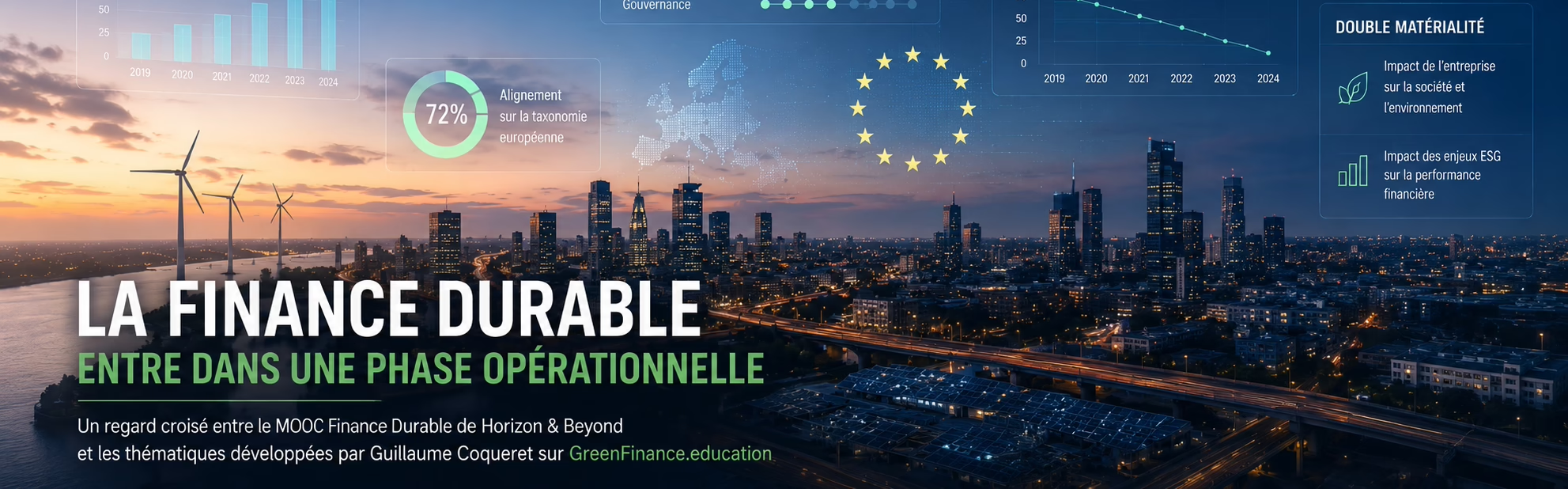
A cross-perspective between Horizon & Beyond’s Sustainable Finance MOOC and the topics developed by Guillaume Coqueret on GreenFinance.education
- Sustainable finance is moving beyond declarative ESG commitments and CSR policies toward a more operational, measurable, and regulation-driven phase shaped largely by European frameworks like the CSRD.
- The concept of double materiality—analyzing both how ESG issues affect a company and how the company impacts its broader ecosystem—has become central to the new European sustainability reporting requirements.
- The quality, comparability, and auditability of ESG data are now critical challenges, as companies and investors must produce reliable information on climate risks, transition pathways, and the real impact of financed activities.
- Climate transition plans must go beyond announcing objectives to demonstrate concretely how the transition will be financed, which investments will be made, and how results will be tracked over time, supporting the rise of transition finance for carbon-intensive sectors.
- Despite remaining challenges around impact measurement, data quality, and greenwashing prevention, sustainable finance is entering a more structured and regulated phase that directly affects business models, investment strategies, and companies' ability to operate within environmental and social boundaries.
European regulation is progressively transforming sustainable finance and investment strategies
For many years, sustainable finance was primarily associated with ESG commitments, CSR policies, labels, and exclusion strategies. These approaches played an essential role in raising awareness of climate and social issues, but they also revealed several limitations: lack of comparability of ESG data, difficulty measuring the real impact of sustainable investments, proliferation of frameworks, and growing concerns around greenwashing.
Today, a new phase seems to be emerging.
Driven by European regulation, the CSRD, new ESG reporting requirements, and climate transition challenges, sustainable finance is gradually becoming more operational, more measurable, and more integrated into real economic decision-making.
This transformation clearly appears in several sequences of Horizon & Beyond’s Sustainable Finance MOOC, as well as in the analyses developed by Guillaume Coqueret on GreenFinance.education, around sustainable market finance, climate risks and financial materiality.
From ESG strategy to operational execution
For a long time, sustainable finance was built around a largely declarative logic:
- “net zero” commitments,
- ESG reporting,
- voluntary charters,
- exclusion policies,
- and long-term climate targets.
But these approaches alone are no longer sufficient to demonstrate a genuine transformation of the economy.
In Chapters 1–2 of the MOOC, Luis Reyes reminds us that finance must first and foremost serve the real economy and play a central role in financing the low-carbon transition. The question is therefore becoming less:
“Who communicates an ESG strategy?”
and increasingly:
“Who is truly transforming investment decisions and economic trajectories?”
This dynamic is also reflected in Guillaume Coqueret’s work on sustainable market finance, particularly regarding financial materiality, climate risks and ESG integration into investment strategies.
CSRD and double materiality: a new stage for sustainable finance
Among the major developments of recent years, the concept of double materiality has become central.
In Chapter 1–3 of the MOOC, Laurent Lascols explains how this concept now goes far beyond traditional financial reporting. Double materiality means analyzing both:
- the impact of ESG (Environmental, Social, and Governance) issues on the company,
- and reciprocally the impact of the company on society and the environment.
This approach now lies at the heart of the CSRD (Corporate Sustainability Reporting Directive), which is progressively transforming ESG reporting practices across European companies.
Sustainability is therefore becoming:
- a governance issue,
- a climate risk management issue,
- a strategic steering issue,
- and no longer merely an exercise in extra-financial communication.
For both companies and investors, European ESG regulation now requires information that is more robust, comparable, and auditable.
ESG data, transition plans and transition finance
The strengthening of European regulation also highlights another key issue: the quality of ESG data.
Companies and investors must now produce more reliable data in order to assess:
- climate risks,
- transition pathways,
- ESG performance,
- and the real impact of financed activities.
Content published on GreenFinance.education also highlights the current limitations of ESG methodologies, the fragmentation of extra-financial data, and the growing challenges related to comparability between companies, investors, and ESG data providers.
This logic also appears in climate transition plans, discussed in Chapter 3–3 of the MOOC by Zoé Ormières-Selves, who emphasizes the importance of concrete strategies aligned with scientific targets and supported by measurable indicators.
The challenge is no longer simply to announce climate objectives or ESG commitments, but to demonstrate how the transition will be financed, which investments will be implemented and how results will be monitored over time.
This movement also supports the rise of transition finance, which aims to finance the progressive transformation of the most carbon-intensive sectors rather than focusing exclusively on assets already considered “green.”
A more structured and mature form of sustainable finance
This evolution does not mean that all challenges have been resolved. Many questions remain:
- how to measure real impact,
- ESG data quality,
- comparability of methodologies,
- credibility of transition plans,
- and the prevention of greenwashing.
But one thing seems increasingly clear: sustainable finance is progressively entering a more structured, more regulated, and more operational phase.
And this transformation now goes far beyond CSR or extra-financial reporting alone:
it directly affects business models, investment strategies, and the way companies manage their transition.
Links
👉 GreenFinance.education – Guillaume Coqueret: https://www.greenfinance.education/
👉 Join Horizon & Beyond’s Essential MOOC to acquire the fundamentals of sustainable finance in less than 2 hours.
👉 Join Horizon & Beyond’s Complete MOOC to better understand the ongoing transformations shaping sustainable finance.
Frequently Asked Questions
Sustainable finance is moving beyond declarative ESG commitments, labels, and exclusion strategies toward a more measurable, regulated, and integrated approach to economic decision-making. Driven by European regulation like the CSRD, the focus is now on demonstrating real transformation of investment decisions and economic trajectories rather than simply communicating ESG strategies.
Double materiality requires companies to analyze both the impact of ESG issues on the company and the impact of the company on its economic, social, and environmental ecosystem. This concept is central to the CSRD (Corporate Sustainability Reporting Directive) and transforms sustainability into a governance, climate risk management, and strategic steering issue rather than just an extra-financial communication exercise.
The strengthening of European regulation makes ESG data quality a key issue, requiring companies and investors to produce more reliable, comparable, and auditable data. This data is essential for assessing climate risks, transition pathways, ESG performance, and the real impact of financed activities.
Transition finance aims to fund the progressive transformation of the most carbon-intensive sectors, rather than focusing exclusively on assets already considered 'green.' It is closely linked to climate transition plans, which require concrete strategies aligned with scientific targets, measurable indicators, and clear demonstrations of how the transition will be financed and monitored over time.
Key unresolved challenges include measuring real impact, ensuring ESG data quality, achieving comparability of methodologies, establishing the credibility of transition plans, and preventing greenwashing. Despite these issues, sustainable finance is clearly entering a more structured and regulated phase that directly affects business models and investment strategies.