- Finance professionals are now integrating climate risks, energy dependencies, supply chain resilience, ESG data quality, and transition pathways alongside traditional financial indicators when analyzing companies.
- Issues once considered 'extra-financial' are increasingly recognized as economically material, shifting the understanding of financial materiality toward longer time horizons and structural resilience.
- For banks, sustainability factors are directly influencing credit risk assessment, financing decisions, and the evaluation of client resilience in the face of energy and economic transitions.
- Investors may now differentiate between companies with similar financial performance based on the credibility of their transition pathways, supply chain resilience, and ESG data quality.
- This transformation requires finance professionals to upskill by understanding sustainable finance frameworks, interpreting ESG data, and connecting finance more closely with strategy and long-term risk analysis.
For a long time, financial analysis was primarily built around well-established indicators such as growth, profitability, solvency, cash generation and valuation.
These elements obviously remain essential.
But other dimensions are increasingly entering the analysis: exposure to climate risks, energy dependencies, supply chain resilience, ESG data quality, transition pathways, governance and the resilience of business models.
And this evolution is changing the way finance professionals assess companies.
A gradual transformation of financial practices
Sustainable finance is not only creating new products or new regulations.
It is also changing the analytical criteria used by investors, banks, analysts, insurers, auditors and finance departments.
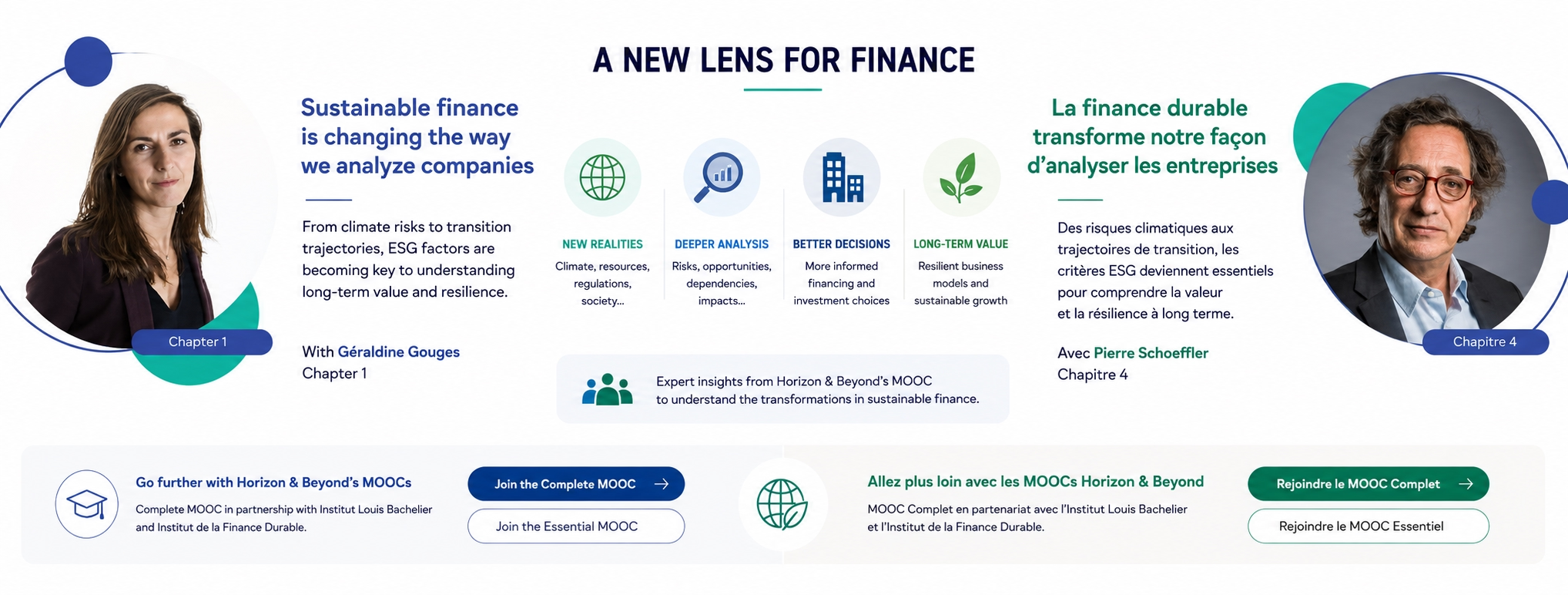
In Horizon & Beyond’s Sustainable Finance MOOC, Geraldine Gouges explains that financial players are now seeking to integrate factors that were previously considered peripheral into their investment decisions and risk analysis.
The objective is no longer only to understand a company’s short-term performance.
It is also about assessing its ability to evolve in a more constrained, more transparent and more transition-driven economic environment.
What professionals are now looking at differently
This evolution is changing the questions companies are being asked.
For example:
- How dependent is a business activity on critical resources?
- What is its exposure to physical or regulatory risks?
- Is its business model compatible with transition pathways?
- Are its ESG data robust and comparable?
- Is its governance capable of managing these transformations?
As a result, sustainability issues are no longer analysed solely as reputational or compliance topics, but increasingly as factors that can influence risks, costs, investments and long-term value creation.
A new understanding of financial materiality
In the MOOC, Pierre Schoeffler also highlights that ESG issues are increasingly integrated into the analysis of the financial materiality of companies and assets.
This reflects a major shift:
Certain dimensions that were long considered “extra-financial” are now viewed as economic factors in their own right.
Time horizons are also evolving.
Beyond quarterly results, investors and financial actors are paying greater attention to resilience, adaptability, structural dependencies and the long-term sustainability of business models.
A transformation that goes beyond regulation
The CSRD, the European Taxonomy and the SFDR are clearly accelerating this transformation.
But the movement is broader than regulation alone.
It also reflects evolving investor expectations, the growing importance of physical and transition-related risks, the increasing role of ESG data and a better understanding of economic and environmental dependencies.
Finance professionals are not just changing their tools, they are changing the way they read companies.
What this changes for banks
For banks, sustainability issues are no longer limited to compliance or reporting.
They are increasingly influencing:
- credit risk assessment,
- financing decisions,
- the analysis of the most exposed sectors,
- and the evaluation of how resilient certain clients are in the face of economic and energy transitions.
A company that heavily depends on cheap energy, scarce resources or fragile supply chains is no longer analysed in the same way as it was ten years ago.
What this changes concretely for investors
Investors are now paying closer attention to the credibility of transition pathways, companies’ adaptability, the resilience of supply chains and the quality of ESG data used to guide strategy.
Two companies with similar financial performance may now present very different profiles in terms of resilience or exposure to future transformations.
A strategic upskilling challenge
This evolution does not mean that every finance professional must become an ESG expert.
But it increasingly requires:
- understanding the main sustainable finance frameworks,
- knowing how to interpret ESG data,
- integrating longer-term time horizons,
- and connecting finance, strategy and risk analysis more closely.
The challenge is not only technical.
It is also about learning how to analyse realities that are more complex and more interconnected than before.
A transformation that is only beginning
Sustainable finance remains a rapidly evolving field.
Data is becoming more important.
Analysis is becoming more sophisticated.
And market expectations continue to evolve.
But one thing already seems clear: the way financial actors analyse companies is changing.
Why upskilling matters
Understanding sustainable finance is not only about learning regulations or acronyms.
It is also about understanding how analytical frameworks, investment decisions and financial market expectations are evolving.
👉 Join Horizon & Beyond’s Complete MOOC, developed in partnership with Institut Louis Bachelier and Institut de la Finance Durable, to gain clear insights into double materiality and the transformations shaping sustainable finance.
👉 Join Horizon & Beyond’s Essential MOOC to acquire the fundamentals of sustainable finance in less than two hours.
Frequently Asked Questions
Finance professionals are integrating factors beyond traditional financial metrics — such as climate risk exposure, energy dependencies, supply chain resilience, and ESG data quality — into their analysis. This shift reflects a growing recognition that sustainability issues directly influence risks, costs, investments, and long-term value creation.
Sustainable finance is expanding the analytical criteria used by investors, banks, analysts, and auditors to include transition pathways, governance quality, and environmental dependencies. Dimensions once considered 'extra-financial' are now treated as economic factors in their own right, influencing credit risk assessment and financing decisions.
Financial materiality in sustainable finance refers to ESG issues that have a direct economic impact on a company's value, risks, and performance. As highlighted in the article, factors previously labeled as extra-financial — such as climate exposure and resource dependencies — are increasingly recognized as material to financial analysis and investment decisions.
The CSRD, European Taxonomy, and SFDR are accelerating the integration of sustainability into financial analysis by setting new disclosure, classification, and reporting standards. However, the transformation goes beyond regulation, also driven by evolving investor expectations, physical and transition risks, and the growing importance of ESG data.
Finance professionals increasingly need to understand key sustainable finance frameworks, interpret ESG data, integrate longer-term time horizons, and connect finance with strategy and risk analysis. While not everyone needs to become an ESG expert, upskilling in these areas is becoming a strategic necessity to navigate more complex and interconnected economic realities.